
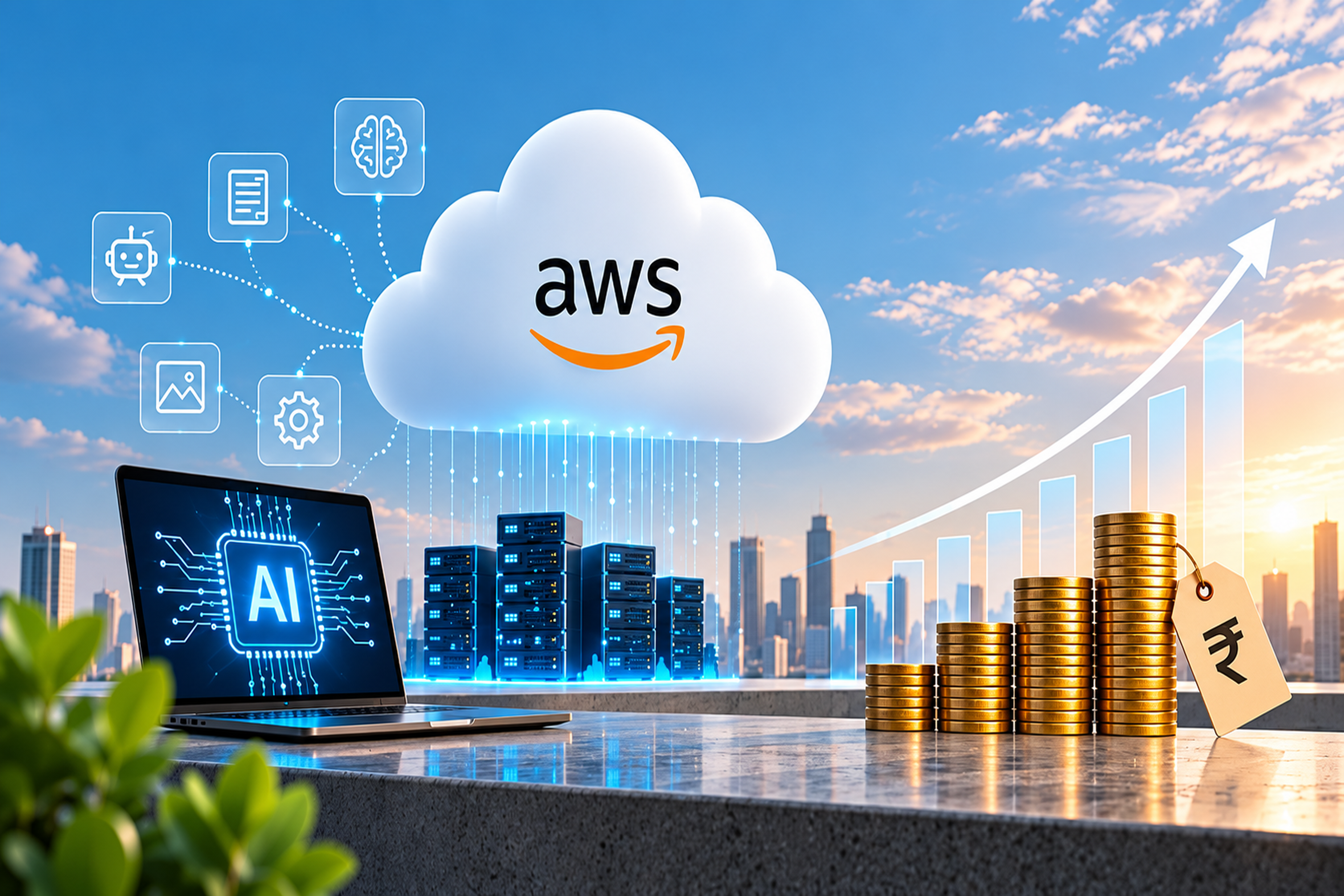
Artificial intelligence is becoming an important part of how businesses operate. From Generative AI applications and intelligent customer support to data analytics and automation, organisations are investing in AI to improve efficiency and create new business opportunities.
However, AI adoption introduces a major operational challenge: rising infrastructure costs.
AI workloads demand significant computing power, storage, data processing, and model inference resources. As businesses move AI applications from experimentation to production, these requirements scale rapidly. Without the right architecture and cost-management practices, organisations end up paying for resources they do not fully use.
This is where AWS consulting makes a tangible difference. An experienced AWS consulting partner assesses an organisation’s cloud environment, identifies sources of unnecessary spending, and implements strategies to improve resource utilisation without compromising application performance.
Executive Summary: Managing AI Cost Drivers
|
AI Cost Driver |
Root Cause |
AWS Consulting Solution |
|
High Compute Demands |
Provisioning resources for peak demand continuously |
Auto-scaling, right-sizing, and idle-resource scheduling |
|
Increasing Inference Usage |
Using expensive models for tasks that do not require them |
Selecting appropriate models and optimising AI workloads |
|
Growing Data Volumes |
Keeping data in higher-cost storage tiers longer than necessary |
Storage lifecycle policies and tiering strategies |
|
Complex Cloud Environments |
Limited visibility into underutilised or unused resources |
Environment assessments, monitoring, and cost tracking |
Read Also: How AWS Partners Enable Enterprise-Ready AI Agents
Why Are AI Infrastructure Costs Increasing?
AI applications have fundamental infrastructure differences compared to traditional business applications. Conventional applications operate on relatively predictable workloads, while AI workloads involve intensive model training, inference, data processing, and storage.
Several key factors drive these rising expenses:
- High Computing Requirements: AI workloads demand substantial computing resources, particularly when organisations train or run large foundation models. The required compute depends on the model architecture, workload type, user concurrency, and request frequency. For applications with variable demand, maintaining resources for peak usage at all times results in wasted expenditure. Matching computing capacity directly to real-time demand is critical for cost efficiency.
- Growing Data Volumes: AI systems rely on massive datasets. Businesses must store documents, customer records, training sets, operational logs, and vector embeddings. As these datasets expand, storage and data-processing costs increase automatically. Without structured data management, organisations continue paying premium rates for high-performance storage long after data access frequency drops.
- Increasing Inference Usage: As AI applications scale, request volumes climb rapidly. Every user interaction triggers model inference, directly driving ongoing operational costs. For Generative AI applications, factors such as model selection, token consumption, and context window size directly dictate overall spending. Optimising these variables reveals immediate opportunities to make workloads more cost-efficient.
- Complex Cloud Environments: Enterprise AI applications rarely operate in isolation. They integrate with databases, APIs, storage, networking, monitoring tools, and security controls. As an AWS environment grows in complexity, identifying which resources are essential versus underutilised becomes difficult. This lack of visibility directly causes budget leaks.
Why Simply Cutting Resources Isn’t the Answer
When cloud bills spike, cutting resources appears to be the quickest fix. However, indiscriminately reducing compute capacity or downgrading to cheaper instances degrades application performance, increases latency, and harms the user experience.
The objective is not to use fewer resources at any cost, but to use the right resources for the workload.
For example, a workload requiring high-performance compute during peak hours does not need that same capacity during off-peak periods. Similarly, an AI application does not require its most powerful model for every basic task. Routine requests are handled efficiently by smaller models, reserving advanced models for complex reasoning. Effective cost optimization requires a deep understanding of the workload to make informed decisions about resources, models, architecture, and usage.
Read Also: How OpenAI on AWS is Revolutionizing the Cloud Industry
How AWS Consulting Can Help Control AI Infrastructure Costs
An AWS consulting partner provides an objective assessment of the cloud environment to identify concrete opportunities for cost reduction:
1. Assessing the Existing AWS Environment
The first step requires a clear audit of current spending. An AWS consultant reviews the organisation’s environment, active workloads, resource utilisation, architecture, and spending trends. This audit pinpoints underused, oversized, duplicated, or orphaned resources, enabling businesses to target optimization efforts where they deliver the highest financial impact.
2. Right-Sizing Cloud Resources
Right-sizing matches resource capacity to actual operational demands rather than over-provisioning out of caution. For AI workloads, this involves evaluating compute nodes, databases, and storage classes against historical usage metrics. This ensures resources satisfy performance needs without paying for idle capacity.
3. Optimising AI Workloads
AI applications offer significant savings when model selection and routing are optimized. Because simple tasks do not require high-parameter models, businesses can route routine prompts to lighter, cost-effective models while saving high-tier models for heavy compute. Streamlining model invocation frequency and token limits further keeps inference costs under control as traffic grows.
4. Improving Resource Utilisation Through Lifecycle Management
While right-sizing addresses instance capacity, lifecycle management controls runtime duration. Development and testing environments rarely need to run 24/7. Scheduling automatic shut-offs outside business hours stops continuous billing for non-production infrastructure.
5. Choosing Appropriate AWS Pricing Options
AWS provides multiple purchasing models tailored to different workload profiles. Predictable, steady-state workloads benefit significantly from Savings Plans or Reserved Instances, whereas unpredictable traffic spikes remain on On-Demand pricing for maximum flexibility. An AWS consultant evaluates these usage patterns to structure the optimal pricing blend.
6. Optimising Storage and Data Management
Storing all application data in high-performance storage indefinitely inflates costs unnecessarily. By analyzing data access frequency and retention requirements, businesses can establish automated lifecycle policies. Moving aged datasets, logs, and archival files to lower-cost tiers, such as Amazon S3 Glacier, maintains accessibility while sharply reducing storage overhead.
Read Also: Recent Microsoft and AWS Outages: A Case for Multi-Cloud and Mitigation Plans
Monitoring Is Essential for Long-Term Cost Control
Cost optimization is an ongoing discipline, not a one-off project. A cloud environment optimized today can see costs drift tomorrow as user adoption expands, new features launch, or workload patterns shift.
AWS provides built-in tools to track cloud spending, resource utilization, and operational metrics. Setting up continuous monitoring, automated budget alerts, and regular architecture reviews helps teams catch unexpected spending anomalies early before they impact the bottom line.
Balancing Cost, Performance, and Scalability
Cost reduction must never compromise application performance or scalability. A low-cost architecture that causes slow response times, system crashes, or poor user experiences ultimately damages the business.
The goal is to build an elastic architecture that scales up seamlessly during demand surges and contracts during quiet periods. Achieving this balance requires deep domain knowledge, where cost considerations are weighed alongside performance, availability, security, and business objectives.
Choosing the Right AWS Consulting Partner
Infrastructure costs are directly connected to architectural health. An inefficient application design inflates compute demands, poor data management raises storage fees, and limited monitoring creates operational blind spots. A partner who addresses root system architecture delivers far more sustainable ROI than one focused solely on short-term bill trimming.
When evaluating an AWS cloud consulting firm, look for key technical capabilities:
- AWS architecture design and cloud engineering expertise
- Proven experience with AI, machine learning, and data-intensive workloads
- Dedicated cloud financial operations (FinOps) and cost optimization capabilities
- Enterprise security, governance, and compliance knowledge
- Managed services, proactive monitoring, and continuous support
- Demonstrated ability to scale cloud architectures as business needs evolve
Read Also: Reducing Overheads: The Benefit of AWS Serverless Cloud Computing
Control AI Costs Without Slowing Down Innovation
AI infrastructure costs naturally increase as adoption grows. The goal is not to halt AI investment, but to ensure every cloud dollar delivers clear business value.
With the right AWS consulting partner, cost management becomes a seamless, ongoing practice within your cloud strategy, allowing your organization to innovate rapidly while keeping infrastructure spending strictly under control.
Ready to Optimize Your AI Infrastructure Costs?
Partner with i2k2 for expert AWS consulting, cloud architecture design, cost optimization, and ongoing managed cloud support.
- Email: sales@i2k2.com
- Phone: +91-120-466-3031 | +91-971-177-4040
- Website: www.i2k2.com
About the Author

Piyush Agrawal – AWS Ambassador | VP Public Cloud & DevOps
Piyush Agrawal is a highly skilled and certified professional in the cloud domain, holding qualifications such as AWS Certified Solution Architect Professional and Associate, ITIL Intermediate (OSA, RCV), and ITIL Foundation. Before joining i2k2, Piyush contributed his expertise to renowned companies including RipenAps, HCL, IBM, and AON Hewitt. With proficiency in diverse fields such as general management, project management, IT operations, cloud operations, product development, application development, business operations, strategy, and non-profit governance, he boasts an impressive track record of delivering results in dynamic and fast-paced environments.