
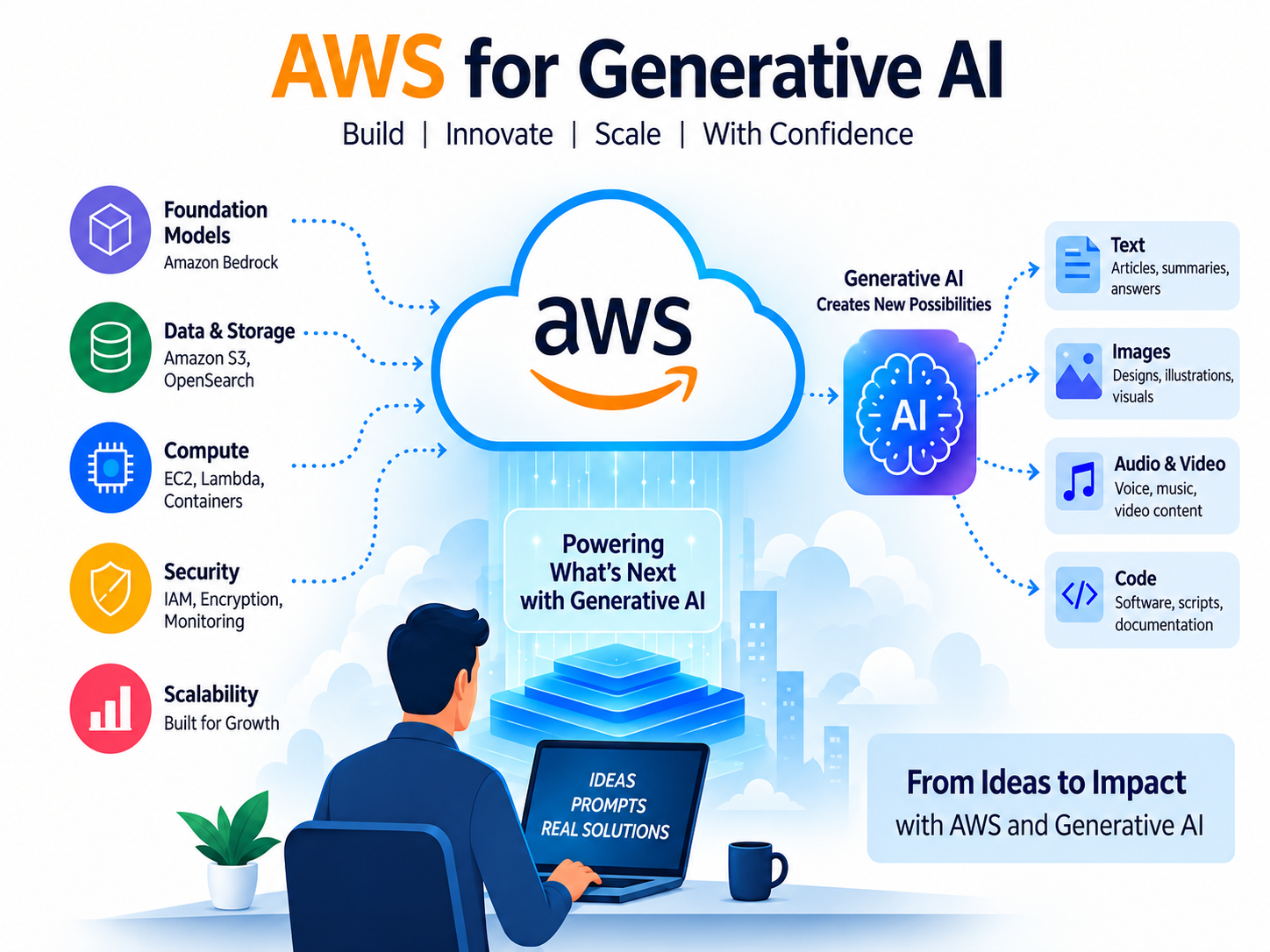
Generative AI is rapidly moving from experimentation to real-world business applications. Organisations are using it to automate tasks, improve customer experiences, analyse information, generate content, and support employees with intelligent tools. However, building a Generative AI application that can reliably handle real business requirements involves more than selecting an AI model. Businesses also need the right infrastructure, data, security controls, scalability, and monitoring capabilities.
Amazon Web Services (AWS) provides a broad range of cloud computing services that can support these requirements. From accessing foundation models through Amazon Bedrock to building and deploying machine learning solutions with Amazon SageMaker, AWS enables businesses to develop Generative AI applications and scale them as their needs grow.
Why Use AWS for Generative AI?
Building a Generative AI application requires an environment that can support both experimentation and production workloads. AWS offers a combination of managed AI services, cloud infrastructure, data services, and security capabilities that help organisations develop these applications without building every component from scratch.
Read Also: How AWS Nova Sonic Model is Transforming Conversational AI
- Model Flexibility: Through Amazon Bedrock, organisations can access foundation models from multiple providers via APIs, evaluating them on performance, latency, context windows, and cost.
- Elastic Infrastructure: AWS allows compute and storage resources to auto-scale dynamically as usage transitions from low-volume prototypes to high-concurrency production deployments.
- Enterprise Data Integration: Securely connect GenAI workflows directly with existing enterprise databases, document repositories, and operational systems to ground responses in proprietary knowledge.
- Built-in Enterprise Security: Integrate identity management, encryption, network isolation, and dedicated AI guardrails into the architecture from day one.
Key AWS Services for Generative AI
While AWS offers a wide array of cloud capabilities, several core services form the foundation of most enterprise Generative AI architectures:
|
AWS Service |
Primary Role in GenAI Architecture |
Key Use Case |
|
Amazon Bedrock |
Serverless access to foundation models via unified APIs |
Rapid prototyping, conversational AI, and text generation without infrastructure management. |
|
Amazon SageMaker |
End-to-end machine learning platform |
Fine-tuning custom models, training proprietary LLMs, and hosting specialized ML pipelines. |
|
Amazon S3 |
Scalable object storage |
Storing raw unstructured datasets, training data, and enterprise document repositories. |
|
Bedrock Knowledge Bases & OpenSearch Service |
Vector databases & retrieval systems |
Indexing vector embeddings for Retrieval-Augmented Generation (RAG) and hybrid search. |
|
Guardrails for Amazon Bedrock |
Application-level safety & policy controls |
Filtering toxic content, masking PII, preventing prompt injection, and curbing hallucinations. |
How to Build a Generative AI Application on AWS
Building a GenAI application should begin with the business problem rather than a specific AWS service or AI model. Following a structured roadmap ensures a smooth transition from initial idea to production deployment.
1. Define the Business Use Case
Establish clear objectives early—whether answering customer questions, searching internal documents, summarising long-form content, or automating workflows. Identify target users, data inputs, latency tolerance, accuracy requirements, and compliance rules.
2. Select the Right Foundation Model
Evaluate models against functional requirements rather than choosing based solely on parameter size or brand popularity. Weigh factors such as response quality, inference latency, token pricing, multimodal capabilities, and context window limits.
3. Connect the Application to Business Data (RAG Architecture)
An AI model alone only knows general information from the internet. To give accurate, business-specific answers, it needs access to your internal files, policies, and product documents.
Read Also: Drive Growth with Smarter Cloud Migrations: Working with an AWS Consulting Partner
Think of it like an open-book exam: instead of forcing the AI to answer from memory, the system quickly searches your company’s internal files, finds the exact right page, and hands it to the AI so it can write an accurate response based on your data.
- The user asks a question – e.g., “What is our refund policy for electronics?”
- System finds the exact company document – Retrieves your latest policy PDF.
- AI reads the document & answers – Generates an accurate, up-to-date answer based on your actual rules.
This approach keeps answers accurate, prevents the AI from guessing, and ensures sensitive internal knowledge stays secure within your organization.
4. Build and Integrate the Application
Develop the front-end interface, API layer, routing logic, and data ingestion pipelines. Implement core operational requirements—such as AWS Identity and Access Management (IAM) role permissions, API gateway throttling, logging, and error handling—during initial development rather than retrofitting them later.
5. Test and Evaluate the Application
Evaluate the application under realistic conditions. Continuously test across multiple vectors: accuracy, hallucination rates, response latency, token consumption costs, and threat resilience.
6. Deploy and Monitor
Deploy the application using serverless compute (AWS Lambda) or containerised options (Amazon ECS/EKS). Set up continuous monitoring to track performance, usage spikes, error rates, and costs once live.
How AWS Helps Make Generative AI Applications Scalable
Moving a Generative AI application from prototype to production introduces new infrastructure demands. An architecture suitable for a small internal trial may fail under high user concurrency.
AWS provides elastic compute and managed APIs to accommodate fluctuating traffic patterns without requiring over-provisioned infrastructure. Managing variable workloads is essential for GenAI, where token consumption and model inference costs scale directly with traffic.
Beyond compute, optimizing response times requires architectural adjustments such as prompt caching, database indexing, and selecting lighter-weight models for high-frequency, low-complexity tasks. Continuous resource monitoring allows teams to optimize latency and cost over time.
Read Also: Know When to Upgrade Your AWS Support Plan: Key Signals from Production
Securing Generative AI Applications on AWS
Enterprise GenAI applications frequently handle sensitive data, customer records, and proprietary IP. Securing these workloads requires multi-layered controls across data, identity, and application runtime:
- Identity & Access Management: Use AWS IAM to enforce least-privilege access across APIs, datasets, and compute resources.
- Data Protection: Apply end-to-end encryption for data at rest (in S3 and vector stores) and data in transit (via TLS).
- AI Safety & Policy Guardrails: Deploy Guardrails for Amazon Bedrock to automatically block prompt injection attempts, redact Personally Identifiable Information (PII), filter inappropriate content, and enforce domain boundary rules.
- Human-in-the-Loop Oversight: Implement human review steps for high-stakes decisions where model inaccuracy carries business or regulatory risk.
Best Practices and Common Pitfalls
To build reliable GenAI solutions on AWS, pair key operational habits with the common pitfalls they prevent:
- Start with a defined use case to prevent scope creep and unnecessary architectural complexity.
- Select models based on workload fit (cost, speed, quality) rather than parameter count alone, avoiding overpaying for simple inference.
- Ground responses using RAG to minimize hallucinations and reliance on static model training data.
- Bake security into the initial architecture rather than attempting to retrofit IAM rules and encryption prior to launch.
- Design for scale from day one to avoid costly structural redesigns when user adoption grows.
- Establish continuous cost and performance tracking to manage token consumption and compute spending as traffic scales.
- Plan the transition from prototype to production early by accounting for error handling, logging, and operational management before rolling out pilots.
Generative AI Use Cases on AWS
The flexibility of the AWS ecosystem supports a diverse range of enterprise GenAI workloads:
- Enterprise Knowledge Assistants: Enable employees to query internal documentation using natural language.
- Customer Support Automation: Power conversational agents capable of retrieving account context and executing workflow actions.
- Document Processing & Synthesis: Automatically extract, summarize, and classify key data points from large document sets.
- Intelligent Search: Upgrade legacy keyword search with semantic, vector-driven contextual search.
- Software Engineering Assistants: Assist development teams with code synthesis, test generation, and documentation.
Read Also: The Smart Way to Run Production on AWS: Partnering with i2k2 Managed Support
Building GenAI Applications on AWS with i2k2
Generative AI success requires more than selecting a foundation model. Moving from proof-of-concept to production demands an end-to-end architectural strategy that balances data pipelines, model evaluation, security, scalability, and cost optimization.
AWS provides the infrastructure foundation, while i2k2 Networks Private Limited provides the hands-on cloud expertise required to build and maintain these environments. As an experienced AWS Consulting Partner, i2k2 assists businesses across every stage of the GenAI lifecycle, from initial architectural design and proof-of-concept development to security implementation, RAG integration, and ongoing cloud management.
Ready to Build Your Enterprise GenAI Solution?
Partner with i2k2 Networks Private Limited to design, deploy, and scale production-ready Generative AI architectures on AWS.
- Email: sales@i2k2.com
- Phone:+91-120-466-3031 | +91-971-177-4040
- Website: www.i2k2.com
About the Author

Piyush Agrawal – AWS Ambassador | VP Public Cloud & DevOps
Piyush Agrawal is a highly skilled and certified professional in the cloud domain, holding qualifications such as AWS Certified Solution Architect Professional and Associate, ITIL Intermediate (OSA, RCV), and ITIL Foundation. Before joining i2k2, Piyush contributed his expertise to renowned companies including RipenAps, HCL, IBM, and AON Hewitt. With proficiency in diverse fields such as general management, project management, IT operations, cloud operations, product development, application development, business operations, strategy, and non-profit governance, he boasts an impressive track record of delivering results in dynamic and fast-paced environments.