
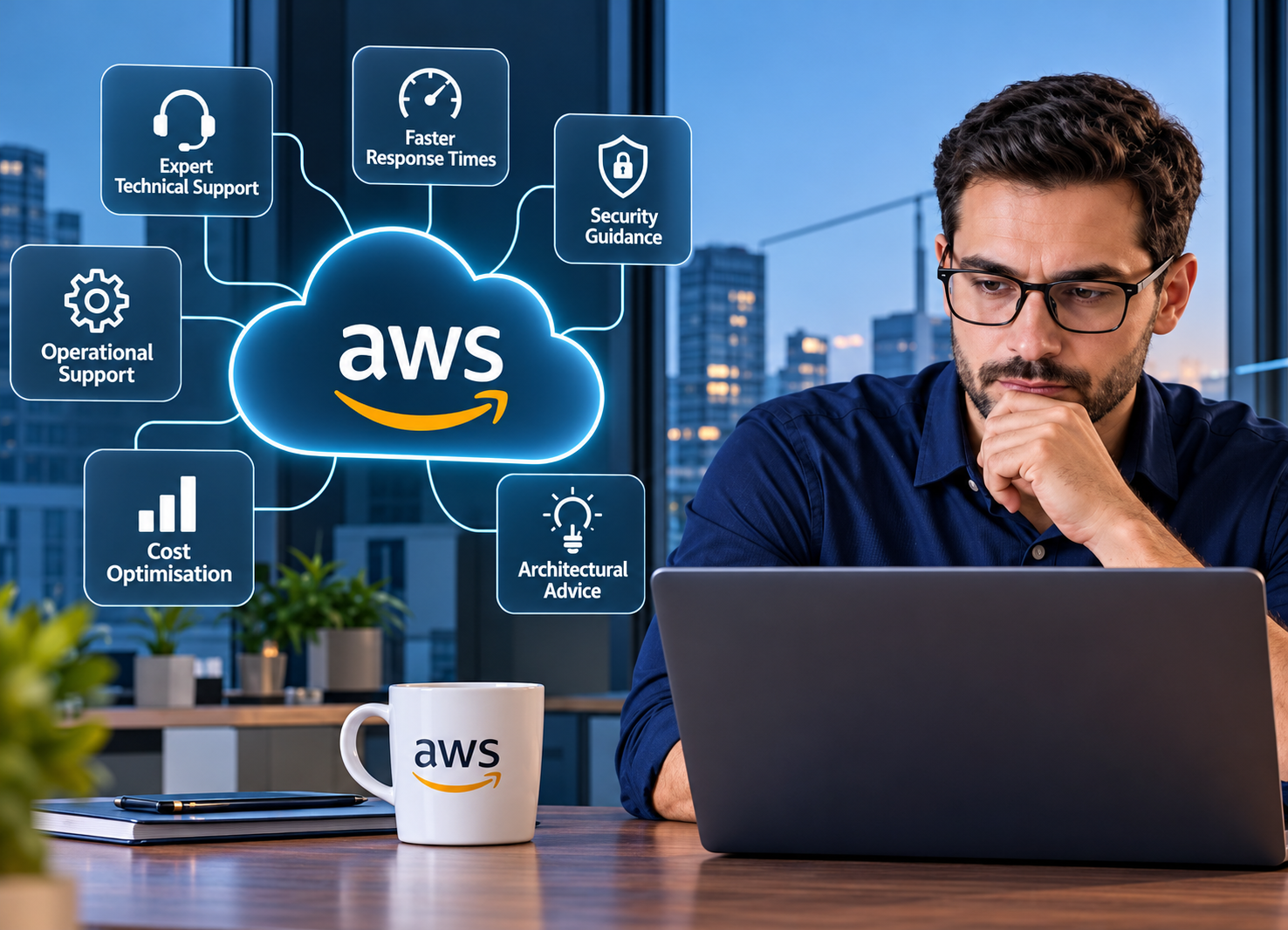
As a business grows, its AWS environment can quickly become more than just the infrastructure supporting a website or application. Increasing workloads, more users, additional AWS services and greater dependence on cloud-based systems can make AWS infrastructure increasingly critical to day-to-day operations. With that growth can come a greater need for timely technical assistance, guidance on performance and security, and help resolving issues that could affect business continuity. This often leads growing businesses to consider AWS Premium Support as a way to gain access to a higher level of AWS expertise and support.
But does paying for enhanced AWS Support services actually make sense for a growing business? The answer depends on how critical AWS is to the organisation, the complexity of its cloud environment, the expertise available internally and the potential cost of downtime or unresolved infrastructure issues. AWS currently offers paid support plans such as Business Support+, Enterprise Support and Unified Operations, while businesses can also consider working with a managed AWS services provider for more hands-on infrastructure management. Understanding these options can help a growing business determine whether enhanced AWS Support is a worthwhile investment for its particular needs.
What Is AWS Premium Support?
AWS Premium Support generally refers to the enhanced support available beyond AWS Basic Support.
Basic Support is included with every AWS account and provides access to documentation, support forums, AWS Health and assistance with account and billing matters. However, businesses operating production workloads often need more than documentation and self-service resources.
AWS Business Support+, for example, provides 24/7 access to AWS Cloud Support Engineers through phone, web and chat, unlimited technical support cases, contextual AI-powered troubleshooting and faster responses for critical production issues. AWS currently identifies Business Support+ as the minimum recommended support plan for production workloads.
Enterprise Support goes further by adding capabilities such as a designated Technical Account Manager (TAM), faster response times for production-critical cases, strategic reviews and additional security and architectural guidance.
For organisations running mission-critical workloads, AWS Unified Operations provides an even higher level of support, including proactive monitoring and application-specific expertise.
Therefore, the question is not simply whether AWS Premium Support is worth the cost. The more useful question is whether the level of AWS Support services matches the business’s operational risk and growth stage.
Read Also: The Smart Way to Run Production on AWS: Partnering with i2k2 Managed Support
Why Growing Businesses May Need Enhanced AWS Support
Growth changes the role that cloud infrastructure plays within a business.
A small company may be able to tolerate occasional service interruptions while an internal developer investigates an issue. The same approach becomes considerably more difficult when AWS hosts an e-commerce platform, customer-facing application, SaaS product, financial system or other business-critical workload.
Several factors can make enhanced AWS Support increasingly valuable.
1. Downtime Becomes More Expensive
As customer numbers and revenue increase, the cost of an AWS-related outage can increase as well.
A production issue affecting a growing online business could prevent customers from accessing applications, completing transactions or using essential services. Even a relatively short interruption can result in lost revenue, reputational damage and additional pressure on internal teams.
Business Support+ currently targets an initial human response within 30 minutes for business-critical system-down cases, while Enterprise Support targets a response within 15 minutes for such critical cases.
For businesses where every minute of downtime matters, faster access to AWS expertise can justify the additional support cost.
2. AWS Environments Become More Complex
Cloud growth rarely means simply adding more servers.
A growing AWS environment may involve Amazon EC2, Amazon RDS, Amazon S3, Amazon CloudFront, Amazon VPC, load balancers, containers, databases, monitoring tools, security services and multiple availability zones or regions.
As these components interact, diagnosing an incident can become more complicated.
Enhanced AWS Support can provide access to engineers who understand AWS services and can help investigate technical problems, recommend appropriate configurations and identify potential causes of performance or availability issues.
3. Internal IT Teams May Become a Bottleneck
A growing business does not necessarily grow its infrastructure team at the same pace.
Developers and internal IT professionals may already be responsible for application development, deployments, security, monitoring and business projects. Having the same team investigate every AWS infrastructure issue can divert valuable resources from strategic work.
Paid AWS Support gives the internal team an additional technical resource when AWS-specific expertise is required.
However, AWS Support should not automatically be viewed as a replacement for an internal DevOps or infrastructure team. It is primarily a source of AWS expertise and technical assistance rather than a substitute for day-to-day infrastructure management.
4. Security and Compliance Requirements Increase
Growth often brings greater security and compliance expectations.
Businesses may need stronger identity controls, better monitoring, improved backup practices, disaster recovery mechanisms and more structured security processes.
AWS Support plans can provide recommendations and guidance around security, performance, reliability and cost optimisation. Higher support tiers also provide additional security-related capabilities. Enterprise Support, for example, includes AWS Security Incident Response at no additional fee under the current support structure.
This can be particularly relevant for organisations handling sensitive customer information or operating workloads where security incidents could have significant consequences.
Read Also: Know When to Upgrade Your AWS Support Plan: Key Signals from Production
What Does AWS Premium Support Include?
The exact benefits depend on the AWS Support tier selected.
Business Support+
Business Support+ is designed for businesses running production workloads that require 24/7 technical support.
Key capabilities include:
- 24/7 access to AWS Cloud Support Engineers
- Phone, web and chat support
- Unlimited technical support cases
- AI-powered, contextual troubleshooting
- Faster response for business-critical issues
- Expanded AWS Trusted Advisor checks
- Third-party software support
- AWS Support API access
- Guidance relating to security, performance, reliability and cost optimisation
Enterprise Support
Enterprise Support is intended for organisations with more business-critical workloads and a greater need for proactive guidance.
In addition to the capabilities available through Business Support+, Enterprise Support includes a designated Technical Account Manager, strategic guidance, architectural reviews and faster response targets for critical production issues.
Unified Operations
Unified Operations is aimed at organisations with mission-critical workloads requiring enhanced resilience and application-specific expertise.
For most growing businesses, therefore, the realistic comparison is likely to be between Basic Support and Business Support+, with Enterprise Support becoming relevant as workloads and operational requirements become substantially more demanding.
Is AWS Premium Support Worth the Cost?
There is no universal answer.
For a business with a simple AWS environment, limited traffic and a technically capable internal team, paying for a higher support tier may not deliver enough additional value.
For a growing business running revenue-generating or customer-facing workloads, the calculation can be very different.
The cost of enhanced support should be compared with the potential cost of:
- Prolonged production outages
- Delayed incident resolution
- Poorly configured infrastructure
- Security vulnerabilities
- Inefficient AWS resource utilisation
- Unexpected cloud expenditure
- Failed deployments
- Performance problems
- Internal engineering time spent troubleshooting infrastructure
If a single major incident could cost considerably more than the annual support investment, enhanced AWS Support can become easier to justify.
The decision should therefore be based on business impact rather than AWS account size alone.
AWS Support vs Managed AWS Support: What Is the Difference?
One important distinction should be made between AWS Support and managed AWS support services.
AWS Support provides access to AWS expertise. A business can raise support cases, receive technical guidance and obtain recommendations based on the selected support tier.
Managed AWS support, on the other hand, involves a service provider taking a more hands-on role in managing the cloud environment.
This distinction can be important for growing businesses that do not have a dedicated DevOps or cloud operations team.
A managed AWS services provider can potentially handle areas such as infrastructure monitoring, deployment, backups, security management, disaster recovery, optimisation and operational troubleshooting.
For example, i2k2 Networks provides managed AWS infrastructure support covering areas such as deployment, backup and restore, security management, disaster recovery, log management, audit management, optimisation and DevOps.
This means a business does not necessarily have to choose between AWS Support and a cloud partner. Depending on its requirements, it may use AWS’s support capabilities alongside a managed services partner that handles day-to-day cloud operations.
When Should a Growing Business Consider AWS Premium Support?
There are several indicators that enhanced AWS Support may be worth considering.
Production workloads have become business-critical: If AWS downtime directly affects customers, revenue or business operations, faster technical assistance can become valuable.
The AWS environment is becoming more complex: Multiple services, accounts, regions and integrations can increase the difficulty of troubleshooting.
The internal team lacks dedicated AWS expertise: A small IT or development team may benefit from access to AWS specialists when complex infrastructure issues arise.
Cloud expenditure is increasing: As AWS spending grows, optimisation and cost-management guidance can have a meaningful financial impact.
Security requirements are becoming stricter: Businesses handling sensitive information may need stronger monitoring, security practices and incident-response capabilities.
The business is preparing for rapid growth: A cloud environment that works for current traffic may not necessarily be ready for a significant increase in users or transactions.
Major launches or migrations are approaching: Additional support can be particularly valuable during periods when infrastructure changes or traffic levels are expected to increase.
Read Also: Reducing Overheads: The Benefit of AWS Serverless Cloud Computing
When Might AWS Premium Support Not Be Necessary?
Enhanced support is not automatically the right choice for every organisation.
A small business with a low-risk workload, limited AWS usage and a technically strong internal team may be comfortable with Basic Support and self-service resources.
Similarly, purchasing an expensive enterprise support tier simply because a company is growing may not provide a meaningful return.
The better approach is to assess the actual risk.
If the business can tolerate downtime, has sufficient internal expertise and operates a relatively straightforward AWS environment, a higher support tier may be difficult to justify.
Conversely, if AWS infrastructure directly supports revenue and customer experience, the cost of support should be viewed as part of the broader cost of maintaining business continuity.
How to Choose the Right AWS Support Level
The decision can be simplified by assessing five areas:
Business criticality: How serious would an AWS outage be?
Response requirements: How quickly does technical assistance need to be available?
Internal expertise: Does the organisation have experienced AWS and DevOps professionals?
Infrastructure complexity: How many AWS services, applications, accounts and environments are involved?
Operational responsibility: Does the internal team want to manage the infrastructure itself, or would a managed service provider be more appropriate?
For many growing businesses running production workloads, Business Support+ may provide a practical starting point. Organisations with highly business-critical or mission-critical workloads may need Enterprise Support or a more comprehensive operational model. AWS itself currently positions Business Support+ as the minimum recommended plan for production workloads.
At the same time, businesses should consider whether they need support from AWS alone or require a partner that can actively manage the environment.
Is AWS Premium Support Worthwhile for Growing Businesses?
For growing businesses, AWS Premium Support can be worthwhile when the cost of downtime, security incidents, infrastructure problems and internal troubleshooting is greater than the cost of enhanced support.
The key is choosing the right level of support rather than simply choosing the most expensive option.
Read Also: How OpenAI on AWS is Revolutionizing the Cloud Industry
Business Support+ can provide 24/7 access to AWS experts, faster critical-incident response and additional optimisation capabilities. Enterprise Support adds a deeper level of strategic and technical engagement, including a designated Technical Account Manager. Larger organisations with mission-critical environments may require even more comprehensive operational capabilities.
However, enhanced AWS Support does not necessarily address every operational requirement. Businesses that need continuous monitoring, infrastructure management, security management, backup, disaster recovery and DevOps assistance may benefit from working with a managed AWS services provider.
For organisations evaluating their next stage of AWS growth, the right question is therefore not simply “Is AWS Premium Support worth it?” but “What level of AWS expertise and operational support does the business actually need?”
Looking for Managed AWS Support?
Growing businesses need an AWS environment that can keep pace with changing workloads without creating unnecessary operational complexity. At i2k2 Networks, we provide AWS infrastructure services, managed support, monitoring, security, backup, disaster recovery, optimisation and DevOps support to help businesses manage and scale their AWS environments.
If you are looking for expert AWS support to manage, optimise and scale your cloud infrastructure, speak to the i2k2 Networks team to understand how managed AWS services can support your business as it grows.
FAQs
1. What is AWS Premium Support?
AWS Premium Support is a commonly used term for AWS’s enhanced paid support offerings. AWS currently provides Business Support+, Enterprise Support and Unified Operations as its main paid support tiers. These plans offer progressively greater access to technical expertise, faster response times and additional operational capabilities.
2. Is AWS Premium Support the same as AWS Business Support+?
Not exactly. “AWS Premium Support” is commonly used as a general term for enhanced AWS Support, whereas Business Support+ is the name of a specific current AWS support plan. Business Support+ is currently positioned by AWS as the minimum recommended plan for production workloads.
3. How much does AWS Premium Support cost?
The cost depends on the AWS Support tier and the organisation’s AWS usage. Actual charges can vary based on AWS usage and the applicable pricing structure.
4. Is AWS Premium Support worth it for a small business?
It depends on the workload rather than simply the size of the business. A small business running a business-critical application on AWS may benefit from enhanced support, while a larger business with low-risk workloads may not need an advanced support tier.
5. Does AWS Premium Support provide 24/7 support?
The current paid AWS Technical Support plans provide 24/7 technical support capabilities. Business Support+, for example, provides 24/7 access to AWS Cloud Support Engineers through phone, web and chat.
6. What is the response time for AWS Business Support+?
AWS Business Support+ currently targets a response within 30 minutes for business-critical system-down cases. Enterprise Support targets a response within 15 minutes for business-critical system-down cases. These are response-time objectives rather than guarantees of issue resolution within those periods.
7. Can a business use AWS Support with a managed service provider?
Yes. AWS Support and managed AWS services address different needs. AWS Technical Support provides access to AWS technical expertise, while a managed service provider can take responsibility for day-to-day infrastructure operations such as monitoring, security, backups, disaster recovery and optimisation.
8. What is the difference between AWS Support and managed AWS support?
AWS Support primarily provides technical assistance, guidance and access to AWS experts. Managed AWS support can provide hands-on operational management of an AWS environment, depending on the service provider and engagement model.
9. Does AWS Premium Support help with AWS cost optimisation?
Yes. AWS’s paid support tiers provide access to capabilities such as AWS Trusted Advisor and cost-optimisation recommendations. Business Support+ includes cost-optimisation capabilities designed to identify opportunities to improve resource utilisation and AWS spending.
10. When should a growing business upgrade its AWS Support plan?
An upgrade may be worth considering when AWS becomes business-critical, infrastructure complexity increases, downtime becomes expensive, internal AWS expertise is limited, or security and operational requirements become more demanding. The decision should be based on business risk and operational requirements rather than revenue or company size alone.
About the Author

Piyush Agrawal – AWS Ambassador | VP Public Cloud & DevOps
Piyush Agrawal is a highly skilled and certified professional in the cloud domain, holding qualifications such as AWS Certified Solution Architect Professional and Associate, ITIL Intermediate (OSA, RCV), and ITIL Foundation. Before joining i2k2, Piyush contributed his expertise to renowned companies including RipenAps, HCL, IBM, and AON Hewitt. With proficiency in diverse fields such as general management, project management, IT operations, cloud operations, product development, application development, business operations, strategy, and non-profit governance, he boasts an impressive track record of delivering results in dynamic and fast-paced environments.